Mary And Ellen
Mariners' Museum, Uncurated Search Results
Type: Pungy
Year: 1881
Builder: W. Skinner & Sons
Location: Baltimore

These records are found in the online catalog of The Mariners’ Museum and Park in Newport News, Virginia. Uncurated search results are presented to give researchers and interested readers an idea of whether the museum’s archives contain information about this vessel and whether it may be worthwhile to visit the museum’s catalog search page for further investigation. Uncurated results may be inaccurate or incomplete.
Search mode: Exact Name. Search phrase(s): "Mary And Ellen"; "Mary & Ellen". Results returned: 16. Results displayed in this table: 15.
Use these buttons to send uncurated search results to your own app or text document for further research. First, check the box for any row, or click "Select All" then uncheck any rows. Then click "Show Selections". You can then copy your selections from the text box and past them into your app.
| Fetch? | Row ID | Media | Date | Vessel | Place | Related Places | Inscription/Marks | Subject | Notes | Archive Number |
|---|---|---|---|---|---|---|---|---|---|---|
| 1 | 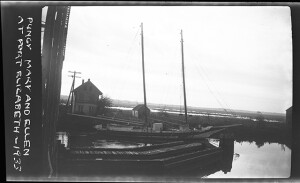 | 1933 | Mary and Ellen (Schooner : 1881). | Envelope: "Pungy. Mary & Ellen. Port Elizabeth, N.J. 1933" Negative: "Pungy Ellen and Alice at Port Elizabeth - 1933" | Pungies–New Jersey–Port Elizabeth.; Schooners–New Jersey–Port Elizabeth.; Dwellings–New Jersey–Port Elizabeth. | Shows a starboard side view of a schooner moored near a marshy shore. In the background is a dwelling, in the foreground is a pier. | MS0063/01-660.2#0660 | |||
| 2 | No image URL. | Mary Ellen | P0001.011/01-2090 | |||||||
| 3 | 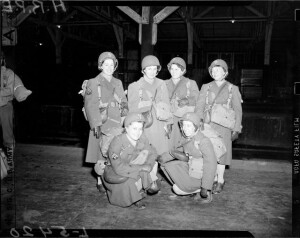 | 11/17/1943 | United States. Army–Officers.; United States. Army. Women's Army Corps.; Empress of Scotland (Steamship : 1942). | Advance detail of 162nd WAC Hq. Co, Unit 6946-G on Pier 6, Newport News, Va. Officer with them is Lt. Conruelo Doggett 2-700187. | Embarkation (Military science). | Shows six WACs standing together on an HRPE pier, two women are crouching down in the front for the photo. The caption on the 8x10 print reads: "Advance detail of the 162nd WAC Headquarters Company, Shipment 6946-G, just before embarking on the EMPRESS OF SCOTLAND (HR-678) on Pier 6. They are as follows: Lt. Conruelo Doggett, Goldsboro, North Carolina, 2-70187; Pvt. Mary Ellen Borden, Liberal, Kansas; Pvt. Yvonne G. Cote, Gardner, Massachusetts; T/5 Josephine M. Jamnick, Cleveland, Ohio; and T/5 Mary Ann McBane, Snoqualmie, Washington." | P0003/01-#L-5420 | |||
| 4 | No image URL. | North Star books ; 28 | Fisheries–New England | The fishing fleets of New England | LB19964 | |||||
| 5 | No image URL. | Seafaring life. | Sailing the Seven Seas __ __illustrated by John O'Hara Cosgrave, II | LB16414 | ||||||
| 6 | No image URL. | Illustrated lining-papers. | LB17500 | |||||||
| 7 | No image URL. | Voyages and travels–Mythology; Mythology, Classical | Voyages in classical mythology __ __Mary Ellen Snodgrass | LB84190 | ||||||
| 8 | No image URL. | North Star books ; [12] | Sailing ships–Juvenile literature. | Donald McKay and the clipper ships | LB19724 | |||||
| 9 | No image URL. | Story of lighthouses. | LB95372 | |||||||
| 10 | No image URL. | Surveying, measuring, and valuing : British transports during the war against revolutionary France. | LB60756 | |||||||
| 11 | 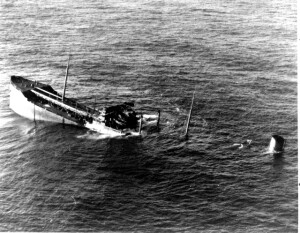 | 1942/03/16 | WRITTEN ON VERSO: FORMERLY MARY ELLEN O'NEAL. BUILT 1928 AT CHESTER, PENNSYLVANIA BY SUN SHIPBUILDING AND DRY DOCK COMPANY.OWNED BY THE TEXAS COMPANY, WAR LOSS MARCH 16, 1942. | Tankers | CURATORS NOTE: Aerial view of vessel sinking. | P0001.003/01-#PB30126 | ||||
| 12 | No image URL. | United States. Navy.; Alabama (Battleship : No. 8).; Charleston (Protected cruiser : No. 22).; Florida (Battleship : No. 30).; Flusser (Destroyer : No. 20).; Kilpatrick (Transport : 1899).; Louisiana (Battleship : No. 19).; Minnesota (Battleship : No. 22).; Missouri (Battleship : No. 11).; Monitor (Ironclad : 1862).; Virginia (Ironclad : 1862).; New York (Battleship : No. 34).; North Carolina (Armored cruiser : No. 12).; Ohio (Battleship : No. 12).; Olympia (Cruiser : No. 6).; Oregon (Battleship : No. 3).; Tennessee (Armored cruiser : No. 10).; Virginia (Battleship : No. 13).; Connecticut (Battleship : No. 18).; New Jersey (Battleship : No. 16).; Pennsylvania (Armored cruiser : No. 4). | Warships–United States.; Battleships–Pictorial works.; Armored vessels–Pictorial works. | This is a collection of post cards of US Navy vessels sent to Ms. Moore by a "very amorous suitor," according to the donor. The suitor was Mr. Harry Braxton Hastings (1894-1956), who clearly loved the Navy and naval ships. The postcards depict vessels from US Steam Battery Monitor to the major battleships and cruisers of the day. Fifteen of these were copyrighted by the noted Navy photographer Enrique Muller. Also depicted are the dock area at the National Soldier's Home in Hampton, which is now a Veteran's Administration hospital, and the naval transport Kilpatrick. Only 3 of the postcards include a handwritten note, and most were never sent by post. The notes contain material about their relationship. | MS0770 | |||||
| 13 | No image URL. | Potomac (Side wheel steamer : 1935). | Potomac River. | Steamboats–Maryland.; Excursion boats.; Piano and theater organ music–Washington (D.C.). | This collection contains one item, a videotape of the steamboat Potomac under way, in 1947. The video was made from an original 16mm color film, made by Bedford F. Penn, for the meeting of the Steamship Historical Society of America. The film includes images of the boat underway, the walking beam and valve lifters in action, a stop / start sequence, the pilot house and deck views. Added to the original silent 16mm film is a mujsical accompaniment composed and performed on a Wurlitzer theater organ by Raymond A. Brumbacher, then organist at the Kennedy Center, in 1988. --SS Potomac, of the Potomac River Line, offered excursion service from 1935 to 1948 during the day to Chapel Point Park (MD), an amusement park at the confluence of the Port Tobacco and Potomac Rivers, and to the various attractions at Colonial Beach, VA. At night, Potomac sailed on moonlight excursion cruises on the Potomac. | MS0842 | ||||
| 14 | 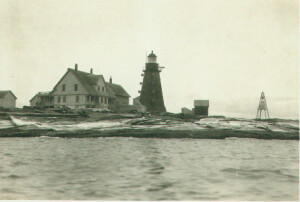 | Mount Desert Island (Me.). | on verso: Mount Desert Lighthouse, Mount Desert Rock, ME. established 1830; 58 ft. high. | Lighthouses. | Distant view of lighthouse and keepers house with water and snow in foreground. History Mount Desert Rock is the farthest land on which a New England coast lighthouse shows its warning 'light in the window.' ...A strange sight, indeed, in a strange place! rising above the waves like the last monument of some buried city of antediluvian times... A bare rock, drenched by every gale, holds the light-tower high above the waves. Far-flung Mount Desert Rock Light is one of the most dramatically isolated of all American lighthouses. More than 20 miles from the nearest port at Mount Desert Island, the low-lying, wave swept rock is, as historian Edward Rowe Snow put it, like "part of another world." George Putnam, for many years the commissioner of the Bureau of Lighthouses, regarded Mount Desert Rock as the most exposed light station in the United States. The tiny rock is only about 17 feet above sea level at its highest point. The French explorer Samuel de Champlain, during his visit to the area in 1604, named Mount Desert Rock and the much larger Mount Desert Island. The name is traditionally pronounced "dessert," like the last course of a meal. Congress appropriated $5,000 for a lighthouse on Mount Desert Rock on March 2, 1829, to aid mariners heading to Frenchman and Blue Hill Bays from the south. The light went into operation on August 25, 1830, with a fixed white light 44 feet above mean high water. Esais Preble was the first keeper and his son, William, was his assistant. The first lighthouse took the form of a short wooden tower at one end of a stone keeper's dwelling, with a system of ten lamps fueled by whale oil. The structure weathered many storms before being replaced for $15,000 by a new 58-foot granite tower in 1847. The new tower was designed by the noted architect Alexander Parris. In 1858, a new lantern was installed along with a third-order Fresnel lens exhibiting a fixed white light. A rotating fourth-order lens replaced the third-order Fresnel lens in 1898, and the characteristic was changed from fixed to a white light flashing every 15 seconds. A second dwelling, a one-and-one-half wood-frame house, was added to the station in 1876. The old stone dwelling was replaced by a wood-frame double dwelling in 1893, providing accommodations for two keepers and their families. Several new outbuildings were added around the same time, and 250 feet of planked walkways were added between the buildings. In 1853, Albert Wood, captain of the steamer Admiral, made a case for a fog bell at Mount Desert Rock. "If a bell were ringing in thick weather," he wrote, "instead of trying to avoid the rock, navigators would calculate to go within hearing distance, get a new course, and proceed up the bay with much more safety." Other local mariners agreed, and an open-frame bell tower, with a 1500-pound fog bell operated by a striking mechanism, was installed in 1856. In 1889, the Lighthouse Board made a case for a powerful fog whistle. Congress soon appropriated $4500 and the new signal was installed. A December 1878 newspaper reported on a particularly bad storm at Mount Desert Rock: Last Tuesday night there swept along the coast of Maine... one of the severest gales that has been experienced in this latitude for years. On the shores of Mount Desert and the other islands around the mouth of the Penobscot and on the main land it was very severe, and out on Mount Desert Rock it must have been terribly wild... On Wednesday evening, the night after the storm, no light was seen in the direction of the rock. Grave fears were entertained that the lighthouse had been washed away, and that the keeper and his family had perished. Thursday and Friday nights passed, and the long-looked-for light was still missing. Then the belief became general that disaster must have befallen the light-house, and it was generally supposed that the house and its inmates had sunk beneath the waves. Owing to the roughness of the sea, there could be no communication with the rock. That Saturday night a light was finally seen and it was learned that the keeper and his family had somehow weathered the storm. In Lighthouses of New England, Edward Rowe Snow told the story of an unusual wreck in the vicinity of Mount Desert Rock in the 1880s. The schooner Helen and Mary, carrying granite from Halifax, sank in a storm near the island. The captain's wife, who was also the sister of the first mate, was on board with her baby girl. When the vessel sank the first mate was able to survive by clinging to some wreckage. As he drifted the mate saw a package floating by. He snatched it from the water and found that it was his sister's baby girl wrapped in oilskin. Air trapped inside the wrapping had kept the baby afloat. The mate held the child close to him through the night and the next day the pair was picked up by the crew of the lighthouse tender Iris. In December 1902, the New York tugboat Astral, with a barge in tow, ran aground at Mount Desert Rock in a gale with 18 men aboard. The situation looked hopeless, but with the arrival of low tide Keeper Fred Robbins and an assistant (Charles H. Newman or William H. C. Dodge) managed to get close enough to the vessel to get a line aboard. All the men except one who had already frozen to death were pulled to safety. The keeper's wife prepared steaming coffee for the survivors, and salve applied to the men's freezing limbs enabled them to recover fully. The crew of the Astral remained at Mount Desert Rock until the storm subsided six days later. Meanwhile, the barge that was being towed by the tug drifted all the way to Rockland with several men safely aboard. Despite its isolation, Mount Desert Rock was for many years a family station. It became a tradition each spring for the families to bring soil to the island for a garden, and local fishermen made contributions of earth from the mainland. By the summer a beautiful flower garden would be in bloom. With luck the flowers would remain until fall, but the first gales of winter would sweep the rock clean of the last bit of dirt. One woman who grew up on Mount Desert Rock told Mary Ellen Chase, author of The Story of Lighthouses: In recent years some vegetation has survived the mild winters at the Rock The people who sailed past called it God's Rock Garden, but it was really mine. I never gave Him my garden, but I've thanked Him all my life for Mount Desert Rock. Vinal O. Beal was one of the early 20th century keepers at the station. His daughter Robina described the unusual way her parents had of making sure she and her siblings were safe when playing outside. A line was attached to Robina's waist, with the other end looped around a clothesline that extended from the house to a derrick. This way the children could not be washed away. Arthur E. Ginn was one of the keepers for a few years around 1920. Ginn lived at the station with his wife, Inez, and their three daughters. During this time, a teacher came to the station for 10 days each month. One day, while Ginn was away getting supplies, a thick fog rolled in. According to family tradition, Ginn's daughters and the children of the other keepers sounded a fog signal (probably a backup bell) for hours so that Ginn would find his way back. He got back safely with the aid of his compass. George York was keeper from 1928 to 1936. His son Wilbur was only two years old when they moved into the station. He later remembered some details of life there helping his father polish brass and lugging coal for the stove, and the excitement of monthly runs for supplies, like 50-pound sacks of flour and 25-pound tubs of peanut butter. One year after a storm the supply boat couldn't get in and the family nearly starved, living on biscuits and molasses. Wilbur's stepmother ran out of lard for biscuits the day before the supplies finally arrived. In 1931-32, a navigational radio beacon was installed at Mount Desert Rock, and generators brought electricity to the light and keeper's house. On October 6, 1962, Hurricane Daisy struck the Rock, destroying the walkway between the house and tower, as well as sweeping away fuel tanks and other structures. The three Coast Guardsmen there at the time spent the night near the top of the lighthouse tower. One of the men, John Baxter, said later: The bad thing was that when we went in the tower you could feel the tower sway, like someone was shaking it. It was scary! The next morning, when things calmed down, we went outside the tower. We had an engine room, probably 90 feet by 90 feet. And it was gone. Crushed. A boulder had rolled up onto the bank and just crushed it. That was really scary then, because we got thinking. What if that boulder had hit that tower? It would've knocked that over, or done a good job on it. There's no way we would've survived it. In spite of the arrival of modern conveniences like television, life for Coast Guard keepers at Mount Desert Rock wasn't much easier than it had been for Lighthouse Service keepers. 20-year-old Douglas Nute, a native of St. Louis, told author Bill Caldwell that he was "ready to scream" after a week at the station. Nute had previously been stationed on Great Duck Island; there, at least, were trees and grass and some space to walk around. In the mid-1970s the Coast Guard removed the lantern of Mount Desert Rock Light to make room for rotating aerobeacons. A combination of public complaints and storm damage to the aerobeacons convinced the Coast Guard to install a new lantern in 1985. The Coast Guard crew constructed a helicopter pad in the mid-1970s. "It took one good storm to wipe it out," says Glenn Gearheart. "There was nothing like watching waves washing over the whole island. We were in the lighthouse. The whole island was vibrating." Courtesy of Glenn Gearheart The last Coast Guard keepers were removed by helicopter in late 1977. The light station was then leased to Bar Harbor's College of the Atlantic for use as a whale watching station. The college's Allied Whale program compiles and maintains catalogs for the North Atlantic populations of finback and humpback whales. More than 4,000 individual humpback whales and 500 finbacks have been cataloged by the group. Researcher Tim Cole told the Christian Science Monitor in 1988: I like to get up into the tower maybe a half-hour before sunrise. As the sky lightens, things gradually start to happen more birds fly by, or a few whales become visible. You can sit and watch as the world starts to move. The generator shed. The College of the Atlantic replaced the roof of the dwelling in 2000. A building formerly used as a generator house was turned into a marine lab. The lighthouse is best seen by private boat or from the air, although whale watches from Bar Harbor occasionally pass near Mount Desert Rock. Inside the base of the tower. August 29, 2009: According to this article, Mount Desert Rock suffered badly from the effects of Hurricane Bill. The boathouse was mostly destroyed, and two walls of the generator shed were swept away. There was also water damage inside the keeper's house. This is a major setback for the College of the Atlantic's programs on the island. As Andrew Peterson, marine facilities superintendent for the college, aptly put it, "When it comes down to it, the ocean always wins." Keepers: Esais Preble (1833-1835); Benjamin Ward Jr. (1841-?); Jacob L. Richardson (1848-1850); David King (1850-1853); Rufus King (1853-1859); George Booth (1859-1860); Joseph Hopkins (1860-1861); William E. Holden (1861-1864); Seth H. Higgins (assistant 1864-1865, principal keeper 1865-1867); J. A. Williken (1867-1868); Otis W. Kent (1868-1872); Amos B. Newman (1872-1881); James A. Morris (1881-1882); Thomas R. Milan (or Mylan) (1882-1902); Fred M. Robbins, second assistant (1898-1899), then first assistant (1899-1902) then principal keeper (1902-1911); Vinal O. Beal, second assistant (1909-1910), first assistant (1910-1911), then principal keeper (1911-c. 1918); Arthur Edward Ginn (c. 1918-early 1920s); R. W. Powers (c. 1928); George York (1928-1936); Robert G. Wass (c. 1930s); Jarvis Barnett (Coast Guard officer in charge, c. 1946-1948); Ralph Demons (or Demmons) (c. 1948-?) Assistant keepers: William Preble (1833-1835); William H. Ward (1855-1858); John Dolliver Jr. (1858-1859); B. Thurber (1859-1864); David Rollins (1865-1867); Dan Ladd (1865); William Gilley (1867); Dan B. Eaton (1867-1871); Perry W. Richardson (1868-1870 and 1871-1872); Amos B. Newman (1870-1872); Mark W. Hodgson, (1872-1882); William P. Sawyer, second assistant (1872-1878); James A. Morris (1874-1876); Frank Collins (1876-1877); Howard P. Robbins, second assistant (1878-1882); William Stanley, assistant (1882-1883); Benjamin Maddox (1883-1888); Howard M. Gilley, second assistant (1883-1887); Lewis F. Sawyer, second assistant (1887-1888), then first assistant (1888-1889); Willis Dolliver, second assistant (1887-1890), then first assistant (1890-1891); William J, Newman, second assistant (1890), then first assistant (1890); Thomas R. Savage, second assistant (1891-1892); Orrin L. Milan, second assistant (1892-1895), then first assistant (1895-1897); Charles Thurston, second assistant (1895-1897), then first assistant (1897-1899); Joseph M. Gray (1900-1901); Bert Richard (c. 1901); Herbert P. Richardson, second assistant (c. 1902); Charles H. Newman (c. 1902-1908); William H. C. Dodge, second assistant (c. 1902-1908); W. P. Kent (1909-1910); Wilbert F. Lurney (or Lurvey?) second assistant (1910), then first assistant (1911-?); Charles A. Radley, second assistant (1911-?); Joseph Muise (c. 1920s); A. H. Kennedy (c. 1932); Everett Quinn, assistant (c. 1935); H. C. Day, assistant (c. 1935); M. J. Hergatt (Coast Guard, c. 1948); H. B. Clement (Coast Guard, c. 1948); John Baxter (Coast Guard, c. 1962); Douglas Nute (Coast Guard, c. 1970s); Gary L. Crossman (Coast Guard, 1973-1974); Glenn Gearhart (Coast Guard, 1974-1975). | MS0190/01-01.35#17 | ||||
| 15 | 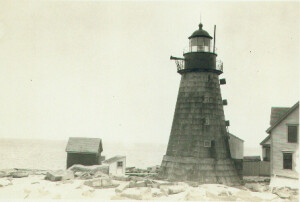 | Mount Desert Island (Me.). | on verso: Mount Desert Lighthouse, Mount Desert Rock, ME. established 1830; 58 ft. high. | Lighthouses. | Distant view of lighthouse and keepers house with water and snow in foreground. History Mount Desert Rock is the farthest land on which a New England coast lighthouse shows its warning 'light in the window.' ...A strange sight, indeed, in a strange place! rising above the waves like the last monument of some buried city of antediluvian times... A bare rock, drenched by every gale, holds the light-tower high above the waves. Far-flung Mount Desert Rock Light is one of the most dramatically isolated of all American lighthouses. More than 20 miles from the nearest port at Mount Desert Island, the low-lying, wave swept rock is, as historian Edward Rowe Snow put it, like "part of another world." George Putnam, for many years the commissioner of the Bureau of Lighthouses, regarded Mount Desert Rock as the most exposed light station in the United States. The tiny rock is only about 17 feet above sea level at its highest point. The French explorer Samuel de Champlain, during his visit to the area in 1604, named Mount Desert Rock and the much larger Mount Desert Island. The name is traditionally pronounced "dessert," like the last course of a meal. Congress appropriated $5,000 for a lighthouse on Mount Desert Rock on March 2, 1829, to aid mariners heading to Frenchman and Blue Hill Bays from the south. The light went into operation on August 25, 1830, with a fixed white light 44 feet above mean high water. Esais Preble was the first keeper and his son, William, was his assistant. The first lighthouse took the form of a short wooden tower at one end of a stone keeper's dwelling, with a system of ten lamps fueled by whale oil. The structure weathered many storms before being replaced for $15,000 by a new 58-foot granite tower in 1847. The new tower was designed by the noted architect Alexander Parris. In 1858, a new lantern was installed along with a third-order Fresnel lens exhibiting a fixed white light. A rotating fourth-order lens replaced the third-order Fresnel lens in 1898, and the characteristic was changed from fixed to a white light flashing every 15 seconds. A second dwelling, a one-and-one-half wood-frame house, was added to the station in 1876. The old stone dwelling was replaced by a wood-frame double dwelling in 1893, providing accommodations for two keepers and their families. Several new outbuildings were added around the same time, and 250 feet of planked walkways were added between the buildings. In 1853, Albert Wood, captain of the steamer Admiral, made a case for a fog bell at Mount Desert Rock. "If a bell were ringing in thick weather," he wrote, "instead of trying to avoid the rock, navigators would calculate to go within hearing distance, get a new course, and proceed up the bay with much more safety." Other local mariners agreed, and an open-frame bell tower, with a 1500-pound fog bell operated by a striking mechanism, was installed in 1856. In 1889, the Lighthouse Board made a case for a powerful fog whistle. Congress soon appropriated $4500 and the new signal was installed. A December 1878 newspaper reported on a particularly bad storm at Mount Desert Rock: Last Tuesday night there swept along the coast of Maine... one of the severest gales that has been experienced in this latitude for years. On the shores of Mount Desert and the other islands around the mouth of the Penobscot and on the main land it was very severe, and out on Mount Desert Rock it must have been terribly wild... On Wednesday evening, the night after the storm, no light was seen in the direction of the rock. Grave fears were entertained that the lighthouse had been washed away, and that the keeper and his family had perished. Thursday and Friday nights passed, and the long-looked-for light was still missing. Then the belief became general that disaster must have befallen the light-house, and it was generally supposed that the house and its inmates had sunk beneath the waves. Owing to the roughness of the sea, there could be no communication with the rock. That Saturday night a light was finally seen and it was learned that the keeper and his family had somehow weathered the storm. In Lighthouses of New England, Edward Rowe Snow told the story of an unusual wreck in the vicinity of Mount Desert Rock in the 1880s. The schooner Helen and Mary, carrying granite from Halifax, sank in a storm near the island. The captain's wife, who was also the sister of the first mate, was on board with her baby girl. When the vessel sank the first mate was able to survive by clinging to some wreckage. As he drifted the mate saw a package floating by. He snatched it from the water and found that it was his sister's baby girl wrapped in oilskin. Air trapped inside the wrapping had kept the baby afloat. The mate held the child close to him through the night and the next day the pair was picked up by the crew of the lighthouse tender Iris. In December 1902, the New York tugboat Astral, with a barge in tow, ran aground at Mount Desert Rock in a gale with 18 men aboard. The situation looked hopeless, but with the arrival of low tide Keeper Fred Robbins and an assistant (Charles H. Newman or William H. C. Dodge) managed to get close enough to the vessel to get a line aboard. All the men except one who had already frozen to death were pulled to safety. The keeper's wife prepared steaming coffee for the survivors, and salve applied to the men's freezing limbs enabled them to recover fully. The crew of the Astral remained at Mount Desert Rock until the storm subsided six days later. Meanwhile, the barge that was being towed by the tug drifted all the way to Rockland with several men safely aboard. Despite its isolation, Mount Desert Rock was for many years a family station. It became a tradition each spring for the families to bring soil to the island for a garden, and local fishermen made contributions of earth from the mainland. By the summer a beautiful flower garden would be in bloom. With luck the flowers would remain until fall, but the first gales of winter would sweep the rock clean of the last bit of dirt. One woman who grew up on Mount Desert Rock told Mary Ellen Chase, author of The Story of Lighthouses: In recent years some vegetation has survived the mild winters at the Rock The people who sailed past called it God's Rock Garden, but it was really mine. I never gave Him my garden, but I've thanked Him all my life for Mount Desert Rock. Vinal O. Beal was one of the early 20th century keepers at the station. His daughter Robina described the unusual way her parents had of making sure she and her siblings were safe when playing outside. A line was attached to Robina's waist, with the other end looped around a clothesline that extended from the house to a derrick. This way the children could not be washed away. Arthur E. Ginn was one of the keepers for a few years around 1920. Ginn lived at the station with his wife, Inez, and their three daughters. During this time, a teacher came to the station for 10 days each month. One day, while Ginn was away getting supplies, a thick fog rolled in. According to family tradition, Ginn's daughters and the children of the other keepers sounded a fog signal (probably a backup bell) for hours so that Ginn would find his way back. He got back safely with the aid of his compass. George York was keeper from 1928 to 1936. His son Wilbur was only two years old when they moved into the station. He later remembered some details of life there helping his father polish brass and lugging coal for the stove, and the excitement of monthly runs for supplies, like 50-pound sacks of flour and 25-pound tubs of peanut butter. One year after a storm the supply boat couldn't get in and the family nearly starved, living on biscuits and molasses. Wilbur's stepmother ran out of lard for biscuits the day before the supplies finally arrived. In 1931-32, a navigational radio beacon was installed at Mount Desert Rock, and generators brought electricity to the light and keeper's house. On October 6, 1962, Hurricane Daisy struck the Rock, destroying the walkway between the house and tower, as well as sweeping away fuel tanks and other structures. The three Coast Guardsmen there at the time spent the night near the top of the lighthouse tower. One of the men, John Baxter, said later: The bad thing was that when we went in the tower you could feel the tower sway, like someone was shaking it. It was scary! The next morning, when things calmed down, we went outside the tower. We had an engine room, probably 90 feet by 90 feet. And it was gone. Crushed. A boulder had rolled up onto the bank and just crushed it. That was really scary then, because we got thinking. What if that boulder had hit that tower? It would've knocked that over, or done a good job on it. There's no way we would've survived it. In spite of the arrival of modern conveniences like television, life for Coast Guard keepers at Mount Desert Rock wasn't much easier than it had been for Lighthouse Service keepers. 20-year-old Douglas Nute, a native of St. Louis, told author Bill Caldwell that he was "ready to scream" after a week at the station. Nute had previously been stationed on Great Duck Island; there, at least, were trees and grass and some space to walk around. In the mid-1970s the Coast Guard removed the lantern of Mount Desert Rock Light to make room for rotating aerobeacons. A combination of public complaints and storm damage to the aerobeacons convinced the Coast Guard to install a new lantern in 1985. The Coast Guard crew constructed a helicopter pad in the mid-1970s. "It took one good storm to wipe it out," says Glenn Gearheart. "There was nothing like watching waves washing over the whole island. We were in the lighthouse. The whole island was vibrating." Courtesy of Glenn Gearheart The last Coast Guard keepers were removed by helicopter in late 1977. The light station was then leased to Bar Harbor's College of the Atlantic for use as a whale watching station. The college's Allied Whale program compiles and maintains catalogs for the North Atlantic populations of finback and humpback whales. More than 4,000 individual humpback whales and 500 finbacks have been cataloged by the group. Researcher Tim Cole told the Christian Science Monitor in 1988: I like to get up into the tower maybe a half-hour before sunrise. As the sky lightens, things gradually start to happen more birds fly by, or a few whales become visible. You can sit and watch as the world starts to move. The generator shed. The College of the Atlantic replaced the roof of the dwelling in 2000. A building formerly used as a generator house was turned into a marine lab. The lighthouse is best seen by private boat or from the air, although whale watches from Bar Harbor occasionally pass near Mount Desert Rock. Inside the base of the tower. August 29, 2009: According to this article, Mount Desert Rock suffered badly from the effects of Hurricane Bill. The boathouse was mostly destroyed, and two walls of the generator shed were swept away. There was also water damage inside the keeper's house. This is a major setback for the College of the Atlantic's programs on the island. As Andrew Peterson, marine facilities superintendent for the college, aptly put it, "When it comes down to it, the ocean always wins." Keepers: Esais Preble (1833-1835); Benjamin Ward Jr. (1841-?); Jacob L. Richardson (1848-1850); David King (1850-1853); Rufus King (1853-1859); George Booth (1859-1860); Joseph Hopkins (1860-1861); William E. Holden (1861-1864); Seth H. Higgins (assistant 1864-1865, principal keeper 1865-1867); J. A. Williken (1867-1868); Otis W. Kent (1868-1872); Amos B. Newman (1872-1881); James A. Morris (1881-1882); Thomas R. Milan (or Mylan) (1882-1902); Fred M. Robbins, second assistant (1898-1899), then first assistant (1899-1902) then principal keeper (1902-1911); Vinal O. Beal, second assistant (1909-1910), first assistant (1910-1911), then principal keeper (1911-c. 1918); Arthur Edward Ginn (c. 1918-early 1920s); R. W. Powers (c. 1928); George York (1928-1936); Robert G. Wass (c. 1930s); Jarvis Barnett (Coast Guard officer in charge, c. 1946-1948); Ralph Demons (or Demmons) (c. 1948-?) Assistant keepers: William Preble (1833-1835); William H. Ward (1855-1858); John Dolliver Jr. (1858-1859); B. Thurber (1859-1864); David Rollins (1865-1867); Dan Ladd (1865); William Gilley (1867); Dan B. Eaton (1867-1871); Perry W. Richardson (1868-1870 and 1871-1872); Amos B. Newman (1870-1872); Mark W. Hodgson, (1872-1882); William P. Sawyer, second assistant (1872-1878); James A. Morris (1874-1876); Frank Collins (1876-1877); Howard P. Robbins, second assistant (1878-1882); William Stanley, assistant (1882-1883); Benjamin Maddox (1883-1888); Howard M. Gilley, second assistant (1883-1887); Lewis F. Sawyer, second assistant (1887-1888), then first assistant (1888-1889); Willis Dolliver, second assistant (1887-1890), then first assistant (1890-1891); William J, Newman, second assistant (1890), then first assistant (1890); Thomas R. Savage, second assistant (1891-1892); Orrin L. Milan, second assistant (1892-1895), then first assistant (1895-1897); Charles Thurston, second assistant (1895-1897), then first assistant (1897-1899); Joseph M. Gray (1900-1901); Bert Richard (c. 1901); Herbert P. Richardson, second assistant (c. 1902); Charles H. Newman (c. 1902-1908); William H. C. Dodge, second assistant (c. 1902-1908); W. P. Kent (1909-1910); Wilbert F. Lurney (or Lurvey?) second assistant (1910), then first assistant (1911-?); Charles A. Radley, second assistant (1911-?); Joseph Muise (c. 1920s); A. H. Kennedy (c. 1932); Everett Quinn, assistant (c. 1935); H. C. Day, assistant (c. 1935); M. J. Hergatt (Coast Guard, c. 1948); H. B. Clement (Coast Guard, c. 1948); John Baxter (Coast Guard, c. 1962); Douglas Nute (Coast Guard, c. 1970s); Gary L. Crossman (Coast Guard, 1973-1974); Glenn Gearhart (Coast Guard, 1974-1975). | MS0190/01-01.35#18 |
Created 2026 by Don Barker, CBMM volunteer, for the Chesapeake Shipbuilding Project. shipbuilding@sailingworkboats.es